
 WEB • SEO • APPS • AI
Industries
Websites for industrial companies that experts actually find.
Engineers, maintenance staff and buyers don't search for slogans but for models, part numbers and error codes. We build websites that answer exactly those questions.
Discuss your projectWhat an industrial website has to do differently
In B2B, decisions are rarely made by one person on the spot. Engineers check the data, purchasing compares quotes, management wants to see references. The website has to serve each of these roles – with precise technical content, downloadable datasheets and proof such as certificates.
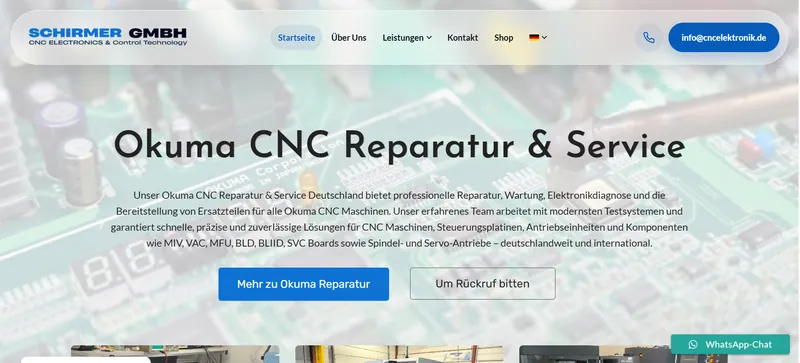
You get found through technical terms: a control designation, a board number, an alarm code – often in English, French or Polish. For the Okuma specialist CNC Elektronik we built expert pages on boards, drives and alarm codes in 11 languages.
And when a line is down, every hour counts. Then nobody wants a detour via the general contact form, but callback, hotline or WhatsApp at a glance – and for projects a quote request that accepts drawings and photos of the type plate.
What your website includes
Built for your daily work.
Technical content
Pages on product series, components and error codes, written in your customers' language – so you appear for specific expert searches.
Catalogue & datasheets
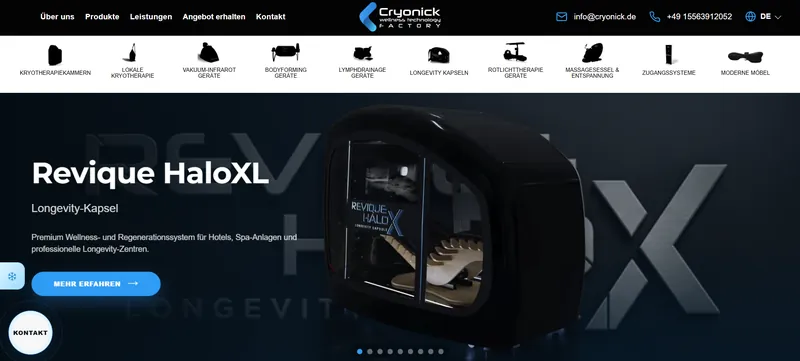
Products and spare parts with specs, filters and PDF downloads – like the B2B catalogue for Cryonick Germany with catalogue and price list.
Request with attachments
RFQ form with machine type, serial number, quantity and upload for drawings or photos – plus callback and hotline for emergencies.
AI search in your documents
An assistant that searches manuals, datasheets and FAQs and gives visitors first technical answers around the clock, with sources.
Examples from practice
Related services
As many as your customers speak. For European export, German and English are the basis, often with French, Polish or Italian. What matters is that technical terms are right in every language – not just machine-translated.
Yes. We turn existing PDFs, catalogues and tables into web pages that can be found, while still offering the originals for download.
It answers typical questions based on your own documents and points to the relevant source. It doesn't replace a service engineer, but takes standard questions off your team. Confidential documents stay out.
Often yes for standard parts with fixed prices. For repairs and custom work a structured request is usually better – the two can be combined.